Descriptive Statements:
- Analyze the group structure of the real numbers (e.g., classifying numbers).
- Apply properties of the real number system (e.g., distributive, associative, identity, properties of equality).
- Solve mathematical and real-world problems involving integers, rational numbers, decimals, and percents.
- Solve mathematical and real-world problems involving ratios, proportions, and average rates of change.
- Solve mathematical and real-world problems involving radical and exponential expressions (e.g., scientific notation).
- Solve mathematical and real-world problems using the principles of basic number theory (e.g., prime factorization, greatest common factor, least common multiple).
Sample Item:
In a school, there are three tutors for algebra. Tutor A meets with students once every 9 days. Tutor B meets with students once every 4 days. Tutor C meets with students once every 6 days. If all tutors are meeting with students today, when is the next time that the tutors will all meet with students on the same day?
- in 24 days
- in 36 days
- in 54 days
- in 60 days
Correct Response and Explanation (Show Correct ResponseHide Correct Response)
B. The tutors will meet on the same day when the number of days that have passed are a common multiple of the period of time each tutor takes between meeting students. The least common multiple of 9, 4, and 6 is 36.
Descriptive Statements:
- Translate informal mathematical language into formal mathematical language, notation, and symbols and vice versa.
- Manipulate algebraic expressions and equations (e.g., solving, factoring, simplifying, rewriting).
- Analyze given mathematical statements, expressions, or definitions in the context of a mathematical or real-world problem.
- Analyze mathematical conjectures, arguments, and informal proofs involving numbers (e.g., use counterexamples to evaluate arguments and disprove claims).
- Justify algebraic techniques using the properties of the real number system (e.g., analyze and evaluate the mathematical thinking and strategies of others).
Sample Item:
Use the expression below to answer the question that follows.
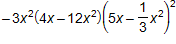
Negative 3 x squared times open parenthesis 4 x minus 12 x squared closed parenthesis times open parenthesis 5 x minus 1 third x squared closed parenthesis squared.
What is the leading coefficient of the expression when it is written in standard form?
- – negative 12
- – negative 3
- 4
- 36
Correct Response and Explanation (Show Correct ResponseHide Correct Response)
B.  Negative 3 x squared times open parentheses 4 x minus 12 x squared closed parentheses equals negative 12 x cubed plus 36 x to the fourth power and
  Open parenthesis 5 x minus 1 third x squared closed parenthesis equals open parenthesis 5 x minus 1 third x squared closed parenthesis times open parenthesis 5 x minus 1 third x squared closed parenthesis equals 25 x squared minus 10 thirds x cubed plus 1 ninth x to the fourth power. . Rewriting the binomial and trinomial factors in standard form yields:
  Open parenthesis 36 times x to the fourth power minus 12 times x cubed closed parenthesis times open parenthesis 1 ninth x to the fourth power minus 10 thirds x cubed plus 25 x squared closed parenthesis. . Since the factors are in standard form, the leading coefficient of the simplified expression is the product of the two leading terms in the polynomial factors:
 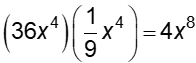 36 x to the fourth power times 1 ninth x to the fourth power equals 4 x to the power of 8. .
Descriptive Statements:
- Apply properties of complex numbers to perform operations and solve problems.
- Represent complex numbers in rectangular and polar form.
- Analyze and compare representations of vector quantities (e.g., graphic, verbal, symbolic).
- Apply vector operations to solve mathematical and real-world problems.
- Apply properties of matrices to perform operations.
- Solve mathematical and real-world problems using properties of matrices.
Sample Item:

 View Cart