Descriptive Statements:
- Understand properties of functions given different representations (e.g., domain, range, one-to-one correspondence).
- Analyze properties of functions given different representations (e.g., meaning of intercepts, verbal descriptions).
- Convert between different representations of relations and functions (e.g., equations, graphs, tables).
- Solve mathematical and real-world problems using operations on functions, including compositions and inverses.
- Evaluate sequences and series (e.g., arithmetic, geometric, sums, recursive definitions).
Sample Item:
The fourth term of an arithmetic sequence is 24 and the seventh term in the sequence is 51. What is the ninth term in the sequence?
- 87
- 78
- 69
- 60
Correct Response and Explanation (Show Correct ResponseHide Correct Response)
C. To move from the fourth term of the arithmetic sequence to the seventh term of the sequence requires three increases of equal size. In those three increases, the sequence must increase from 24 to 51, a distance of 27 units. As a result, each increase must be 9 units. To reach the ninth term from the seventh requires 2 increases of 9 units. 51 plus 9 plus 9 yields the response 69.
Descriptive Statements:
- Analyze the relationship between a linear, quadratic, or higher-degree polynomial function and its graph.
- Transform linear, quadratic, and higher-degree polynomial functions and build new functions from existing functions.
- Solve linear and quadratic equations and inequalities using a variety of methods.
- Solve systems of linear equations or inequalities using a variety of methods.
- Solve higher-degree polynomial equations and inequalities in one and two variables.
- Analyze the characteristics of linear, quadratic, and higher-degree polynomial equations (e.g., relative extrema, end behaviors, average rate of change).
- Solve real-world problems by modeling them with linear, quadratic, or higher-degree polynomial functions.
Sample Item:
Use the graph below to answer the question that follows.
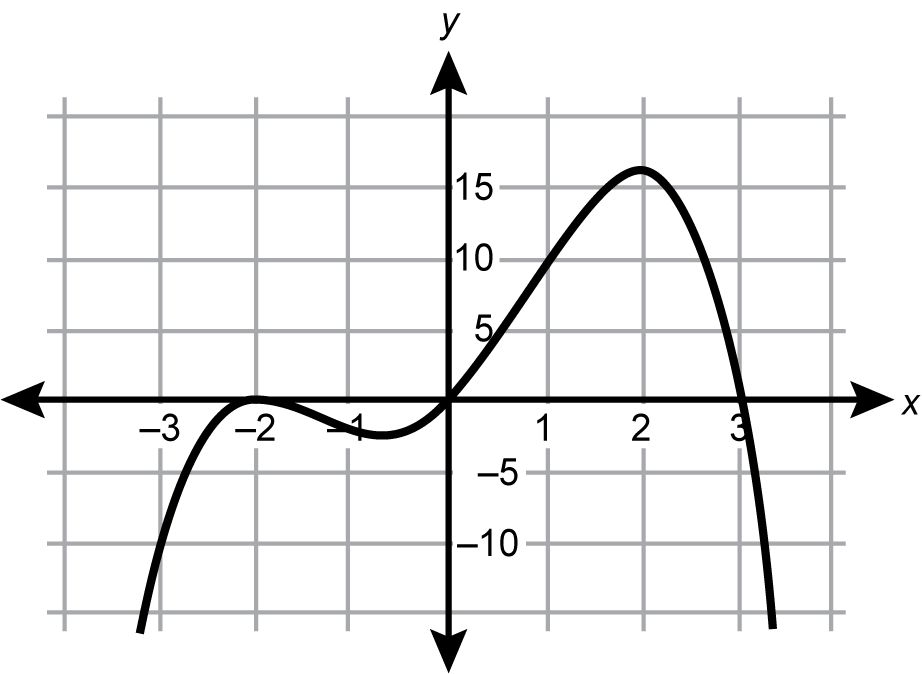
A polynomial function is shown in the coordinate plane on the x interval from negative 4 to 4. The function passes through the origin, and it is decreasing as x approaches negative infinity and positive infinity. The function has a relative maximum at the point negative 2 comma zero, and the function has an absolute maximum at the point 2 comma 16.
Which of the following functions is shown in the graph?
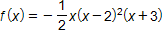 f of x equals negative one half x times open parenthesis x minus 2 close parenthesis squared open parenthesis x plus 3 close parenthesis
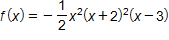 f of x equals negative one half x squared times open parenthesis x plus 2 close parenthesis squared open parenthesis x minus 3 close parenthesis
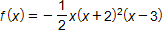 f of x equals negative one half x times open parenthesis x plus 2 close parenthesis squared open parenthesis x minus 3 close parenthesis
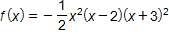 f of x equals negative one half x squared times open parenthesis x minus 2 close parenthesis open parenthesis x plus 3 close parenthesis squared
Correct Response and Explanation (Show Correct ResponseHide Correct Response)
C. The function shown has zeros at – negative 2, 0, and 3. Because it has end behavior such that the function approaches negative infinity for large and small x values, the function has even degree. Response C has an even degree of 4, and substituting – negative 2, 0, or 3 into the function results in a function value of 0.
Descriptive Statements:
- Apply the properties of exponents and logarithms.
- Analyze the relationship between exponential and logarithmic functions.
- Analyze exponential and logarithmic functions and their graphs.
- Solve real-world problems by modeling them with exponential or logarithmic functions.
- Transform exponential and logarithmic functions and build new functions from existing functions.
Sample Item:
What is the y-intercept for the graph of the function 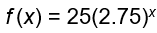 f of x equals 25 times 2.75 to the x power ?
- 0
- 1
- 2.75
- 25
Correct Response and Explanation (Show Correct ResponseHide Correct Response)
D. The function f(x) f of x is an exponential function of the form abx a times b to the power of x . For functions of this form, the y-intercept will be the coefficient a. Therefore, the y-intercept of this function is 25.
Descriptive Statements:
- Transform rational, radical, and absolute value functions and build new functions from existing functions.
- Analyze the relationship between a function (e.g., rational, radical, absolute value, piecewise defined) and its graph.
- Analyze rational, radical, absolute value, and piecewise defined functions in terms of domain, range, and asymptotes.
- Solve real-world problems by modeling them with rational, radical, absolute value, or piecewise defined functions.
Sample Item:
Use the equation below to answer the question that follows.
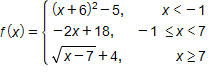
f of x equals the quantity x plus 6 squared minus 5 when x is less than negative 1, negative 2 x plus 18 when x is greater than or equal to negative 1 and less than 7, and square root of the quantity x minus 7 plus 4 when x is greater than or equal to 7.
Which of the following functions is shown in the graph?
- [7, ∞) open square bracket 7 comma infinity close parenthesis
- [– negative 5, 20]
- [7, 20]
- [–5, ∞) open square bracket negative 5 comma infinity close parenthesis
Correct Response and Explanation (Show Correct ResponseHide Correct Response)
D. The range of the function is the set of all values the function can take when evaluated at any x value in its domain. The first section of the piecewise function represents a parabola with vertex at (6, – negative 5) and which opens upward. As a result, the range includes all values greater than or equal to – negative 5. The second section of the function is linear with a y-intercept of 18 (which is already in the range) and a slope of – negative 2. Between x = 0 and x = 7, the value of the function will decrease 14 units, to f(x) f of x = 4. Since all function values between the start and end of this section are already in the range, the range remains all values greater than or equal to – negative 5. The last section of the function begins at x = 7, for which it has a value of 4. As x increases from 4, the value of the radical term will increase, and the value of the function will increase. As such, no values smaller than – negative 5 are in the range. The range is therefore all values greater than – negative 5, inclusive. This is written [–5, ∞) open square bracket negative 5 comma infinity close parenthesis in interval notation.

 View Cart