Descriptive Statements:
- Analyze the use of various units and unit conversions within the customary and metric systems (e.g., choosing appropriate units).
- Solve real-world problems that require converting between different units of measurement.
- Apply the concepts of similarity, scale factors, and proportional reasoning to solve mathematical and real-world measurement problems.
- Analyze precision, error, and rounding in measurements and computed quantities.
- Apply the concepts of perimeter, circumference, area, surface area, and volume to solve problems (e.g., effects of doubling and tripling units on area and/or volume).
Sample Item:
Square ABCD A B C D is defined in the coordinate plane with vertices A(– negative 1, – negative 1), B(– negative 1, 4), C(4, 4), and D(4, – negative 1). Square A'B'C'D' A prime B prime C prime D prime is formed by dilating ABCD A B C D by a factor of 2 about the point (1, 1). What percent of the area of A'B'C'D' A prime B prime C prime D prime is in the first quadrant?
- 49%
- 64%
- 79%
- 81%
Correct Response and Explanation (Show Correct ResponseHide Correct Response)
A. Square ABCD A B C D has side lengths of 5 units and an area of 25 square units. The dilated square A'B'C'D' A prime B prime C prime D prime has vertices at A' A prime (– negative 3, – negative 3), B' B prime (– negative 3, 7), C' C prime (7, 7), and D' D prime (7, – negative 3). This gives it side lengths of 10 units and an area of 100 square units. The portion of the dilated square that is in quadrant one therefore has dimensions of 7 units by 7 units and an area of 49 square units. As a percentage of the entire dilated square, the portion in quadrant one is 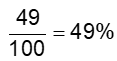 49 divided by 100 equals 49 percent .
Descriptive Statements:
- Solve applied and theoretical problems using the characteristics of triangles (e.g., centroid, orthocenter) and of right triangles (e.g., basic trigonometric ratios).
- Solve mathematical and real-world problems using properties of polygons and circles.
- Solve mathematical and real-world problems using the Pythagorean theorem and its converse.
- Analyze formal and informal geometric proofs using geometric concepts (e.g., similarity, congruence, applications of parallel and perpendicular lines).
- Analyze three-dimensional figures using nets and cross sections.
- Analyze methods for constructing geometric figures.
Sample Item:
Use the incomplete proof below to answer the question that follows.
Given:
m∠RPQ = m∠PSQ = 90° the measure of angle R P Q equals the measure of angle P S Q equals 90 degrees
Prove:
△SPR ∼ △SQP triangle S P R is similar to triangle S Q P
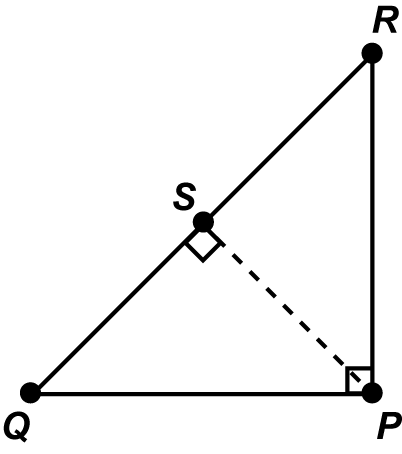
a right triangle R P Q is shown with right angle R P Q. An altitude from side R Q is drawn through point P.
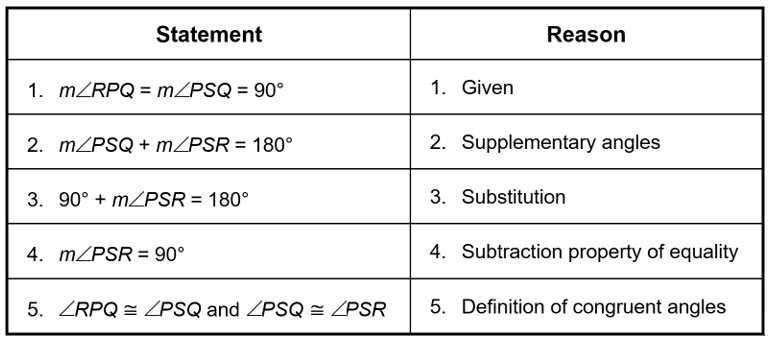
Proof line 1: measure of angle R P Q equals measure of angle P S Q equals 90 degrees. Reason: Given.
Proof line 2: measure of angle P S Q plus measure of angle P S R equals 180 degrees. Reason: Supplementary angles.
Proof line 3: 90 degrees plus measure of angle P S R equals 180 degrees. Reason: Substitution.
Proof line 4: measure of angle P S R equals 90 degrees. Reason: Subtraction property of equality.
Proof line 5: angle R P Q is congruent to angle P S Q and angle P S Q is congruent to angle P S R. Reason: Definition of congruent angles.
Which of the following strategies would help complete the proof?
- using the reflexive property of congruence to show that ∠QPR ≅ ∠SPQ angle Q P R is congruent to angle S P Q and ∠SRP ≅ ∠PQR angle S R P is congruent to angle P Q R , and then using the AA postulate to show that △PQR ∼ △SQP triangle P Q R is similar to triangle S Q P and △PQR ∼ △SPR triangle P Q R is similar to triangle S P R
- using the reflexive property of congruence to show that ∠PQR ≅ ∠SPQ angle P Q R is congruent to angle S P Q and ∠SRP ≅ ∠PQR angle S R P is congruent to angle P Q R , and then using the transitive property of similarity to show that △PQR ∼ △SQP triangle P Q R is similar to triangle S Q P and △PQR ∼ △SPR triangle P Q R is similar to triangle S P R
- using the reflexive property of congruence to show that ∠PQR ≅ ∠SQP angle P Q R is congruent to angle S Q P and ∠SRP ≅ ∠PQR angle S R P is congruent to angle P Q R , and then using the AA postulate to show that △PQR ∼ △SQP triangle P Q R is similar to triangle S Q P and △PQR ∼ △SPR triangle P Q R is similar to triangle S P R
- using the reflexive property of congruence to show that ∠PQR ≅ ∠SQP angle P Q R is congruent to angle S Q P and ∠SRP ≅ ∠PRQ angle S R P is congruent to angle P R Q , and then using the transitive property of similarity to show that △PQR ∼ △SQP triangle P Q R is similar to triangle S Q P and △PQR ∼ △SPR triangle P Q R is similar to triangle S P R
Correct Response and Explanation (Show Correct ResponseHide Correct Response)
C. The reflexive property of congruence states that angles are congruent to themselves. By showing that ∠PQR angle P Q R is congruent to ∠SQP angle S Q P and that ∠PQR angle P Q R is congruent to ∠SPR angle S P R , the proof would establish that each of the smaller triangles shares two angles with the largest triangle, enabling the use of the angle-angle postulate to prove all three triangles are similar.
Descriptive Statements:
- Analyze two- and three-dimensional figures using coordinate systems.
- Apply concepts of distance, midpoint, and slope to classify figures and solve problems in the coordinate plane.
- Apply the concepts of parallel and perpendicular lines to model and solve problems.
- Analyze the relationship between the equation of a conic section and its graph.
- Determine the effects of geometric transformations on the graph of a function or relation (e.g., translations, reflections, dilations).
- Analyze transformations and symmetries of figures in the coordinate plane.
Sample Item:
Use the graph below to answer the question that follows.
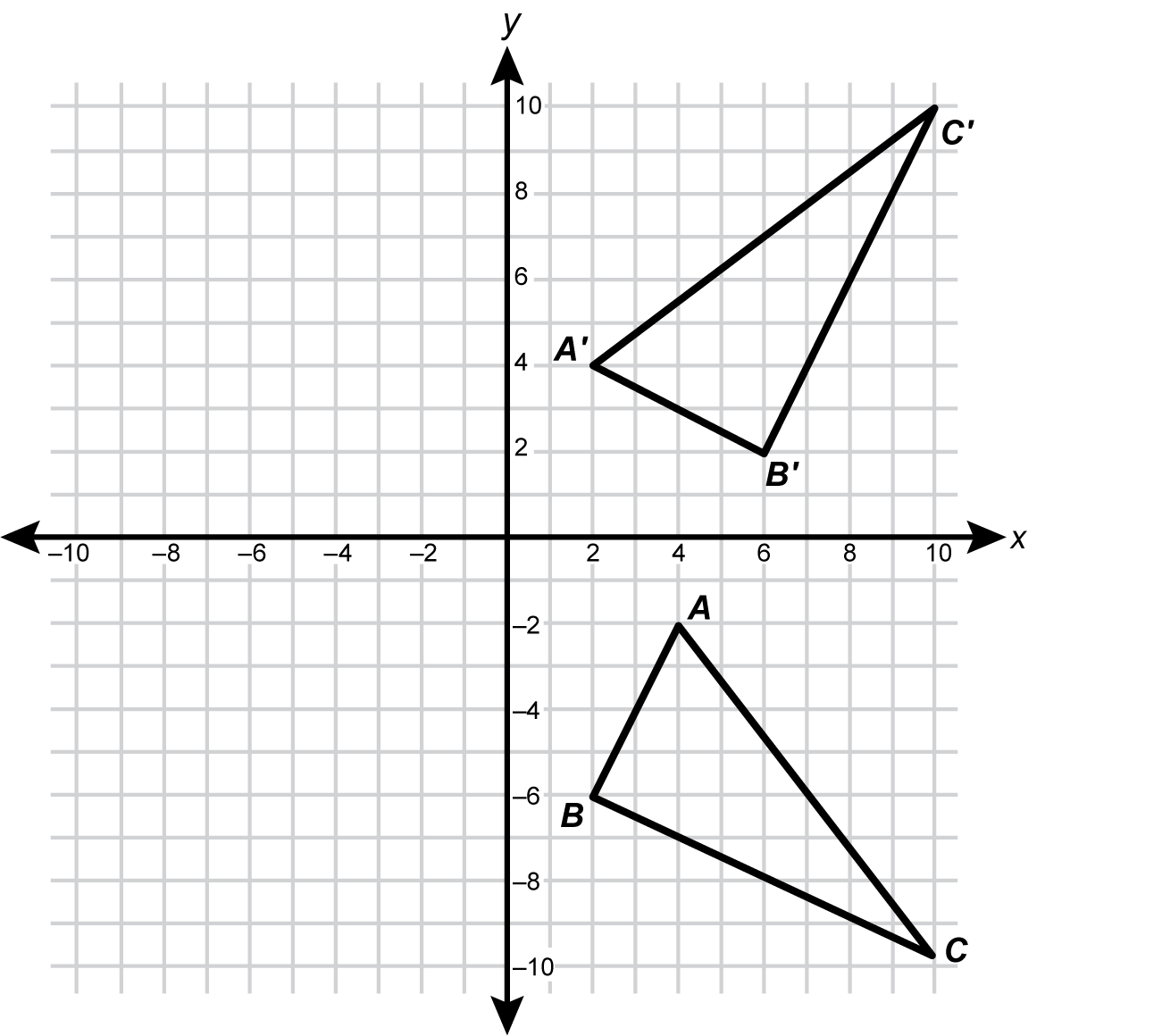
A coordinate plane with point A located at four comma negative 2, point B located at two comma negative 6, and point C located at 10 comma negative 10. Points A, B, and C are connected by line segments to form a triangle. The transformation of triangle A B C is also shown with points A prime located at 2 comma four, B prime located at 6 comma 2, and C prime located at 10 comma 10.
Which of the following transformations maps △ABC triangle A B C onto △A'B'C' triangle A prime B prime C prime ?
- a 90° degree counterclockwise rotation about the origin
- a 180° degree counterclockwise rotation about the origin
- a reflection over the y-axis and a translation
- a reflection over the x-axis and a translation
Correct Response and Explanation (Show Correct ResponseHide Correct Response)
A. A counterclockwise rotation about the origin maps a given point (x, y) to (– negative y, x). This transformation maps point A(4, – negative 2) to A' A prime (2, 4), point B(2, – negative 6) to B' B prime (6, 2), and point C(10, – negative 10) to C' C prime (10, 10).

 View Cart